Safe Routes to School National Partnership - logo  
 

E-News  |  Contact

Changing the Habits of an Entire Generation
Home About Us Local State National Get Involved Media Center
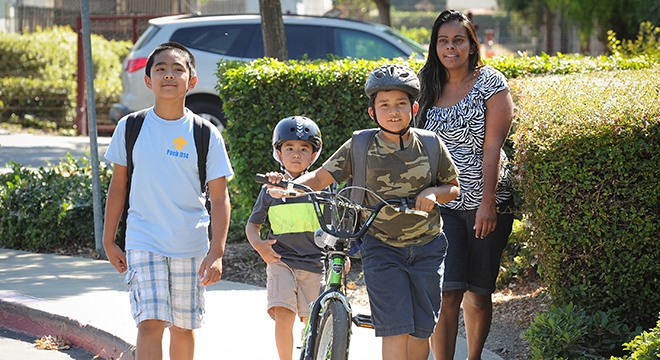
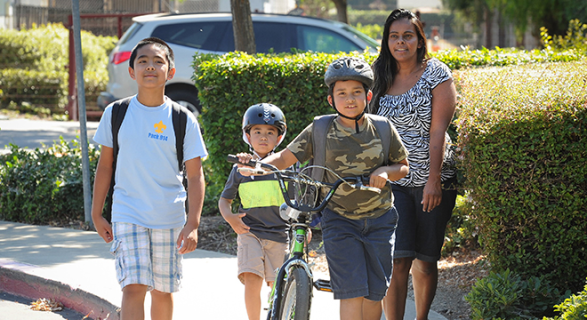
Pictures of children and adults walking and riding bikes.
 
 
State Network Project
State Network Update
State Network Primer
RWJF State Network Grant
Network Resources
SRTS in Your State
State Policies: Best Practices
State Resources
FHWA Resources
 
Home > State > State Network Project > California

Print page     Email page


California

Marin County, California, Walk to School Day

California SRTS State Network
California is one of ten jurisdictions participating in the SRTS National Partnership Network Project. This initiative creates state networks that bring together advocacy groups, public agencies, nonprofits, and other leaders.

California Safe Routes To School Programs
Managed by the California Department of Transportation (Caltrans), California administers two separate Programs: the State-legislated SR2S Program and the federally-legislated SRTS Program. For information on the two Safe Routes to School funding Programs and contact information, go to: www.dot.ca.gov/hq/LocalPrograms/saferoutes/saferoutes.htm. NOTE: this website is in the process of being updated so meantime, contact Joyce Parks, Safe Routes to School Coordinator (contact information is shown below).

Success Stories and Best Practices

Other Statewide and Regional Programs

California Partner Affiliates
Find out which organizations in your state have pledged their support as partner affiliates of the Safe Routes to School National Partnership.

Legislation and Policies


California SRTS State Network
California is one of the ten jurisdictions participating in the SRTS National Partnership
State Network Project. The California SRTS State Network Organizer works for a sponsoring organization, which is under contract with the SRTS National Partnership.

California State Network Organizer
Brooke Driesse, Program Associate
SRTS National Partnership
(858) 412-3363
brooke@saferoutespartnership.org
www.saferoutespartnership.org

California State Network Chair
Deb Hubsmith, Director
SRTS National Partnership
(415) 454-7430
saferoutes@bikesbelong.org
www.saferoutespartnership.org

California State Network Partners
Active Living Research, San Diego State University Foundation
Alta Planning + Design
Association of Cities, Counties, and Schools Partnership
CA Center for Physical Activity, CDPH
Calfiornia State PTA
California Bicycle Coalition
California Center for Cities & Schools
California League of Cities
California Office of Traffic Safety 
California WALKS
CalPED, Senior Action Network: SF WALKS
Caltrans Local Assistance, SRTS
CaltransTribal Affairs
Center for Civic Participation & Youth Development
Chief of Staff, California State Assembly Member Nell Soto
Injury Prevention & Control, CDPH
Kaiser Community Health Initiative
LA Unified School District
Local Government Commission 
Operation LifeSaver
PPHPartners
Prevention Institute
Rails to Trails Conservancy
SF Municipal Transportation Authority
Solano Transportation Authority
Transportation and Land Use Coalition (Bay Area)
UCB Traffic Safety Center
WalkSacramento
WalkSanDiego


California SRTS Programs
California’s Safe Routes to School program is managed by the California Department of Transportation (Caltrans).

Caltrans SRTS Coordinator
Joyce Parks
(916) 653-6920
joyce_parks@dot.ca.gov
http://www.dot.ca.gov/hq/LocalPrograms/saferoutes/saferoutes.htm (NOTE: this website is in the process of being updated so meantime, contact Joyce Parks, Safe Routes to School Coordinator)

California SRTS Federal Funding
California’s SRTS federal funding totals $67,533,954 and includes the following annual apportionments:

2005 Actual 2006 Actual 2007 Actual 2008 Actual 2009 Projected
$1,000,000  $11,039,310 $14,832,295 $18,066,131 $22,596,218

Applications, Guidelines & Project Awards
The final call for federal grant applications for the 2009 funds was announced on April 25, 2008 with an application deadline of July 18, 2008 for $46M. There is one application format for both infrastructure and non-infrastructure applications. Caltrans completed the cycle 1 call for federal projects (encompassing years 2005 through 2008 of the federal funding) in fall 2006 and announced selected projects in June 2007.
A call for projects in Cycle 7 of the State-legislated SR2S Program (included FY 2006-07 and 2007-08) was announced in August 2007. The deadline for applications was November 16, 2007 with an extension to November 30, 2007 granted for the 7 counties affected by the October wildfires. A total of 489 applications requesting a total of $206,462,813 were received for the $52M available; 139 of the applications were funded. The approved list of selected projects can be viewed here.

State Advisory Committee
The California SRTS Advisory Committee reports to Caltrans and was originally established to oversee the California SRTS program that launched in 2000 with the passage of the first-ever statewide SRTS bill. The current advisory committee includes representatives from: the California Department of Education, the California Department of Public Health, the California Highway Patrol, cities, counties, advocacy organizations, and key Caltrans staff. There may be a need to expand the committee in the future.

The Advisory Committee helped develop the SRTS application guidelines and worked with sub-committees to evaluate and recommend selected projects for funding. The Advisory Committee meets on an as-needed basis.

State Outreach Programs
The Caltrans SRTS Coordinator provided SRTS training for the Cycle 1 federal program in each of the twelve Caltrans districts. These trainings were free and open to all eligible applicants. There are plans to employ a consultant who will conduct the bulk of statewide outreach on a one-time basis.

Evaluation Methods
A “Before/After Study Report” form is sent to the grantee at the time of award. This report asks for a number and percentage count of existing (before) and increased (after) bicycling and walking and should be submitted after the project is completed. Grantees also must electronically complete and submit the Student Tally form and the Parent Survey developed by the National Center for SRTS.

There is also a 20-page evaluation form including pages which are required by the federal government and must be completed by the grantee and the SRTS Coordinator. Due to the sheer volume of projects in California, Caltrans, using SRTS funds, will hire a contractor to focus on the evaluation work.


Success Stories and Best Practices

Marin County, California: Local Funding Model
The Transportation Authority of Marin’s Safe Routes to Schools (SR2S) program is currently in 43 schools in Marin County, California, serving 18,000 students including almost all public elementary schools, middle schools, and high schools, as well as a few private schools. There are teams in each school run by either parents or students, with a teacher advisor who organizes encouragement programs. Trained instructors teach pedestrian and bicycle safety curriculum as well as health and environmental lessons.

In November of 2004, Marin County voters passed Measure A, a 20-year transportation sales tax that included 11% of the funding, or $36 million for Marin’s Safe Routes to School program. This local funding allows the County to serve all grade levels, including high school.

Contact:
Wendi Kallins
Program Director, Safe Routes to Schools
(415) 488-4101
wendi@marinbike.org
http://www.saferoutestoschools.org/index.html


Other Statewide and Regional Programs and Resources

California Center for Physical Activity: Education, Encouragement and Enforcement
California Department of Public Health’s
Center for Physical Activity and State and Local Injury Control Section have recently been jointly awarded a multi-year SRTS non-infrastructure grant to provide technical assistance and training for SRTS education, encouragement, and enforcement programs state-wide. The web site is under development. The center works through strategic alliances with physical activity experts, local health departments, community-based organizations and like-minded public- and private-sector partners. Other California Center for Physical Activity projects include:

California Walk to School Headquarters
Healthy Transportation Network
Home Zones
Local Public Health and the Built Environment Network
School Siting and Joint-Use Facilities
Walkable Community Workshops

California Health Interview Survey (CHIS)
CHIS is a comprehensive source of health information in California.  CHIS data are used by legislators, policy makers, local health departments, state agencies, community organizations, advocacy groups, foundations, researchers, and many others. 


Legislation and Policies

California SRTS Bill
In 1999, California approved the first statewide Safe Routes to School bill (AB 1475). The bill established a “one-third” distribution formula for federal safety funds to be allocated in equal amounts to: state highways, local roads, and Safe Routes to School (SRTS) construction program. Funds for the California SRTS program are distributed through a statewide competition and are used for the construction near schools of bicycle and pedestrian safety and traffic calming projects such as sidewalks, trails, bike lanes, and intersection improvements. The
Caltrans report (.pdf download) summarizes the success of the first six years of the state’s SRTS program in increasing walking and bicycling to schools.

Subsequent SRTS bills in 2002 (SB 10) and in 2004 (SB 1087) extended the program through its current sunset date of January 1, 2008. The current SRTS bill, AB 57, extends California’s SRTS program indefinitely, but ongoing appropriations for the state program must be considered each year as part of the state budget process.

AB 57 Update
On Sunday October 14, 2007, Governor Schwarzenegger signed AB57, California's 2007 Safe Routes to School bill. The bill is extremely important as it:  1) enables $52 million in existing state SR2S funding to be spent after January 1, 2008 (the date that the current SR2S bill expires), 2) allows for federal SR2S funds to be swapped for state funds (easing administration burdens on local agencies), and 3) creates a framework for state SRTS funding to be included in the state budget.  The $52 million in existing state SR2S funds is currently available, and the deadline to apply for grants was November 16, 2007. To view the updated SR2S application and guidelines, please visit Caltrans website.

AB 321 - Helps reduce school zone traffic speeds
On January 1, 2008, a new law will take effect that will help bring down traffic speeds in school zones. This law, authored by Pedro Nava (D-Santa Barbara), enables local government to extend school zones to 1000 feet and reduce the speed limit within 500 ft of a school site to 15 mph at schools that are located in residential areas, or on highways with a speed limit of 30 mph or less.

At 15 mph, most pedestrians will survive a crash, often sustaining only minor injuries. Yet minor increases in impact speed have a profound effect on crash severity. At 20 mph, most pedestrian crashes result in serious injury, and almost half are fatal. At 40 mph, 90% of crashes are fatal. Reducing traffic speeds will enable more children to walk or bike to school safely.

This law is voluntary. In order to benefit from it, parents and school administrators need to go to their city councils, or county boards of supervisors, if living outside city limits, and ask them to enact this law at qualifying schools. 

The following cities/counties have adopted AB321: City of Goleta and Santa Barbara County.

AB321 Text
City of Goleta Sample Resolution - Part 1
City of Goleta Sample Resolution - Part 2
Guide for Parents and Government Staff on How to Implement AB321

School Siting
The SRTS State Network formed The Ad-Hoc Coalition for Healthy School Siting, made up of a group of organizations - including Center for Cities & Schools; Cities Counties Schools Partnership; Local Government Commission; Prevention Institute; the Safe Routes to School National Partnership and Strategic Alliance. This group spearheaded an effort to research and write a letter to the California Department of Education, urging them to revise current regulatory requirement with respect to school siting while they are undergoing their current document revisions. Over forty California-based organizations signed on in support of the letter, which outlines the effects of school siting on student’s learning environments, community design, sprawl or the preservation of agricultural lands, and the ability for children to walk and bicycle to schools.

Other State & Regional Policies
Caltrans Deputy Directive 64: Within Caltrans, Deputy Directive 64 requires all department projects to consider the accommodation of non-motorized modes in developing a project. That directive is in the process of being strengthened.

Complete Streets, legislation pending, AB1358: Adds a requirement that in city and county General Plan updates, the Circulation or Transportation Element must include a complete street policy.

Student Wellness: California has multi-pronged student wellness efforts including school district adoption of a school wellness policy.

Education Curriculum: The California State Department of Public Health has just been awarded a SRTS grant to develop statewide walking and bicycling to school curriculum, training and technical assistance.

Fine-based Funding: Three counties in California tested the impact of doubling fines for traffic violations in school zones. Efforts to institute a statewide Double Fines in School Zones law are being pursued.

State Highway Safety Program (SHSP): Making Walking and Street Crossing Safer, Challenge Area 8, includes support for safe routes to school programs as one of its strategies. Improving Bicycling Safety is Challenge Area 13 and also includes a mention of safe routes to school. As part of the Strategic Highway Safety Implementation Plan, actions to implement safety strategies aimed at reducing the walking and bicycling 20 percent of all traffic fatalities are in the process of development.

Bike/Ped Facilities (Bay Area):  Regionally, the Metropolitan Transportation Commission’s Routine Accommodation Checklist with Guidance, is required to be completed, showing that the need for walking, bicycling and ADA facilities has been considered in each Bay Area Transportation project using funds administered by or through the MTC.


Home  |  About Us  |  Local  |  State  |  National  |  Get Involved  |  Media Center  |  E-News  |  Contact  |  Site Map  |  Login
© Copyright 2007 Safe Routes to School National Partnership (SRTSNP). All rights reserved. |  Privacy Policy